
After getting this question multiple times, I thought about posting something to give some overarching advice, but, due to the increasing intensity of my day job, I haven’t been able to carve out the time to think through and compose an article on this topic. Fortunately, when I don’t have time to write an article on a topic that I find interesting, I can reach out to my network and find an expert to help me out by sharing his/her expertise.
In this entry, Paul Freiberger, a career management expert, offers his advice on how a job applicant can recover when a job interview doesn’t go as well as hoped. As someone who has interviewed a lot of people in my career, I can attest to how on-point his guidance is in this piece. I’m thankful that he saw fit to contribute this article.
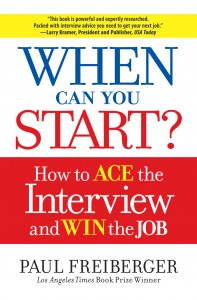
Incidentally, Paul just released a new book called “When Can You Start? How to Ace the Interview and Win the Job“ and, in it, he gives a ton of advice on how one can start off on the right foot and not even have to worry about bouncing back after falling flat in an interview. ïŠ
——
Recovering During and After a Bad Interview
By Paul Freiberger
Job interviews come in all flavors. Some are great, some are good and some are mediocre. Sometimes, though, things go wrong in one way or another. Sometimes everything goes wrong.
What steps can you take to salvage an interview that has somehow taken a wrong turn?
The nature of the job interview help needed depends on specifics. Sometimes, you realize things have gone wrong while you’re still mid-interview, and the blame lies at the feet of the interviewer.
For the interviewer who is unprepared, the one who seems to have paid no attention to your professional resume, be prepared to fill the gaps yourself. You’ll need to hit your resume highlights on your own, but don’t feel that you should expand on every job you’ve ever held and every skill you have. Hit the highlights. Practice your own sales pitch as part of your preparation, honing that pitch down to the two or three most important points that you want to get across. Focus on your biggest strengths and the way they relate to the job for which you’ve applied.
For the silent interviewer, the one who seems willing to tolerate a full hour of dead air, ask questions. Another part of your interview preparation should be a comprehensive look at the company in question. Arrive with a list of questions that you can ask, and that list will always serve you well. Almost every interview, good and bad, will conclude with an opportunity for the interviewee to ask questions, and good questions can be even more impressive than good answers. When an interviewer has nothing to say, your questions can fill the void.
Sometimes, however, the fault is not in our stars, but in ourselves, despite our best efforts. Perhaps you’ve realized that you omitted something very important from one of your answers, a particular accomplishment that would have really wowed them. If you come to that realization soon enough, you can supplement one of your answers before you walk out the door. Be straightforward and low-key: “If I can return to a topic we were talking about a few minutes ago, I wanted to add something that had slipped my mind.â€
The most difficult problem comes when the interview is over. You’ve said your goodbyes, but you’re convinced that the interview went badly. How can you put things right?
The first order of business is to take a closer look at your own opinion. It’s entirely possible that the interviewer does not think your performance was quite as bad as you remember. Post-interview ruminations are an ideal time to go overboard in self-criticism. We can always find things that we could have done better. If you try to improve things after the fact, you run the risk of calling attention to issues that did not trouble your interviewer at all.
Be sure, then, that it really makes sense to revisit things, and be careful of attributing too much negativity to an interviewer simply because he wasn’t enormously effusive. Not every interviewer is naturally outgoing and enthusiastic, so don’t read too much into a person’s body language or facial expression.
If you are convinced that something went wrong, follow up with a thank-you note that addresses the problem.
The easiest problem to address is the simple omission. You answered a question and left out an important point. Send a note expressing your thanks for the opportunity, and add a sentence or two about the critical piece of information that was overlooked. Don’t write an essay. Keep it short and clear.
You can use that same approach to correct a simple mistake, but, again, be sure that it’s worth calling attention to something that your interviewer may not have noticed at all – until, of course, you insisted on reminding him.
It’s one thing to make small mistakes that can be corrected, but there are those interviews that are beyond redemption. It happens. It’s not a reason to throw in the towel. Almost everyone, including the rest of the people applying for this job, has had a bad interview at one time or another, but some good can come out of the experience even if you know that this interview is a lost cause.
There is no better learning experience than the one that is provided by real life. Interview practice, no matter how diligently you pursue it and no matter how valuable it is, cannot duplicate the pressures of the real thing. In fact, the worst interview can provide the best preparation. If you let it, it can teach you how to avoid making those same mistakes when the next opportunity comes along. If you take that approach, you’ve salvaged something of real and lasting value.
——
Paul Freiberger is the author of When Can You Start? How to Ace the Interview and Win the Job (Career Upshift Productions, 2013). He is also the President of Shimmering Resumes, a career counseling and professional resume writing company in Northern California.

You must be logged in to post a comment.